Release Preview
PRM-as-a-Judge 1.5 Is Coming
We are preparing PRM-as-a-Judge 1.5 for mid-July 2026: a more accessible toolkit, a more complete analysis package, and a technical report. This preview summarizes the main direction of the release: correcting a PPL sensitivity issue found in real evaluation practice, and lifting dense OPD curves into higher-level trajectory diagnostics.
In short: PRM-as-a-Judge 1.5 turns dense progress curves into higher-level trajectory diagnostics, so model developers can analyze failure-side progress, recovery after drawdown, and success-side execution quality more directly.
A PPL Correction Found Through Orca Collaboration
During our close collaboration with the BAAI Orca world-model team on embodied action evaluation, we found that the old PPL definition could be too sensitive to the final few frames. A rollout may already reach a meaningful high-progress state, then drop slightly at the end because of release motion, object contact, camera jitter, or a short unstable correction. In that case, using terminal progress can underestimate a trajectory that actually reached its best state efficiently.
Path Length
Old PPL
New PPL
The new PPL keeps the original process-efficiency idea, but anchors it to the best progress state reached by the rollout. Repeated back-and-forth behavior is still penalized through a longer path length, while final-frame noise no longer dominates the score.
Higher-Level Trajectory Diagnostics
PRM-as-a-Judge 1.5 also introduces a compact set of higher-level diagnostics distilled from OPD signals. In plain terms, they answer three questions: when a rollout fails, how much did it still move the task forward; when progress drops, can the model recover; and when a rollout succeeds, how clean and stable was the execution.
Let a rollout produce normalized progress values p0, ..., pT. We use MaxP = maxt pt, SRτ = 1[MaxP reaches the success threshold], M50 = 1[MaxP ≥ 0.50], and M75 = 1[MaxP ≥ 0.75].
FNS
For failed rollouts only: how much useful progress the model still makes before it fails.
DRR
After the largest setback: how much progress the rollout can recover.
SQS
For successful rollouts only: how clean, stable, and efficient the execution is.
MaxP-F is reported separately as the raw average best progress under failed trajectories, . It is intentionally simpler than FNS: MaxP-F asks only how far failed rollouts got, while FNS adds milestone structure to show whether those failures were genuinely near-success cases.
Serving Stronger Embodied Evaluation Workflows
PRM-as-a-Judge has already served Orca, the new flagship world model from BAAI, through a deep collaboration with the BAAI Orca team. Orca first learns a latent world representation and then uses downstream readouts for language, vision, and action. In the action-generation evaluation, PRM-as-a-Judge provides trajectory-level diagnostics beyond binary success, making it possible to compare how deeply each method progresses, how much failed rollouts approach success, and how well execution recovers after regressions.
| Setting / Model | M25 ↑ | M50 ↑ | SR ↑ | MaxP-F ↑ | FNS ↑ | DRR ↑ | SQS ↑ |
|---|---|---|---|---|---|---|---|
| Environment OOD | |||||||
| V-JEPA 2.1 | 40 | 12 | 0 | 23.0 | 13.9 | 25.8 | 0.0 |
| Qwen3.5 | 26 | 10 | 0 | 18.3 | 11.2 | 19.2 | 0.0 |
| π0.5 | 54 | 16 | 2 | 27.9 | 17.7 | 31.5 | 1.5 |
| Orca | 64 | 16 | 4 | 33.9 | 19.3 | 32.9 | 1.8 |
| Object OOD | |||||||
| V-JEPA 2.1 | 14 | 2 | 0 | 11.8 | 6.3 | 15.2 | 0.0 |
| Qwen3.5 | 10 | 0 | 0 | 7.9 | 4.0 | 4.61 | 0.0 |
| π0.5 | 54 | 12 | 8 | 25.1 | 12.9 | 21.9 | 4.5 |
| Orca | 46 | 12 | 8 | 21.8 | 10.8 | 27.7 | 3.9 |
| Overall | |||||||
| V-JEPA 2.1 | 27 | 7 | 0 | 17.4 | 10.1 | 20.5 | 0.0 |
| Qwen3.5 | 18 | 5 | 0 | 13.1 | 7.6 | 11.9 | 0.0 |
| π0.5 | 54 | 14 | 5 | 26.5 | 15.3 | 26.7 | 3.0 |
| Orca | 55 | 14 | 6 | 27.9 | 15.1 | 30.3 | 2.9 |
The results show that Orca's world-learning representation transfers effectively to embodied action readouts: it leads the overall comparison on M25, SR, MaxP-F, and DRR, while remaining highly competitive on FNS and SQS. The strong DRR is especially meaningful because it suggests better recovery after execution errors, not only better early progress.
Orca action evaluation qualitative examples
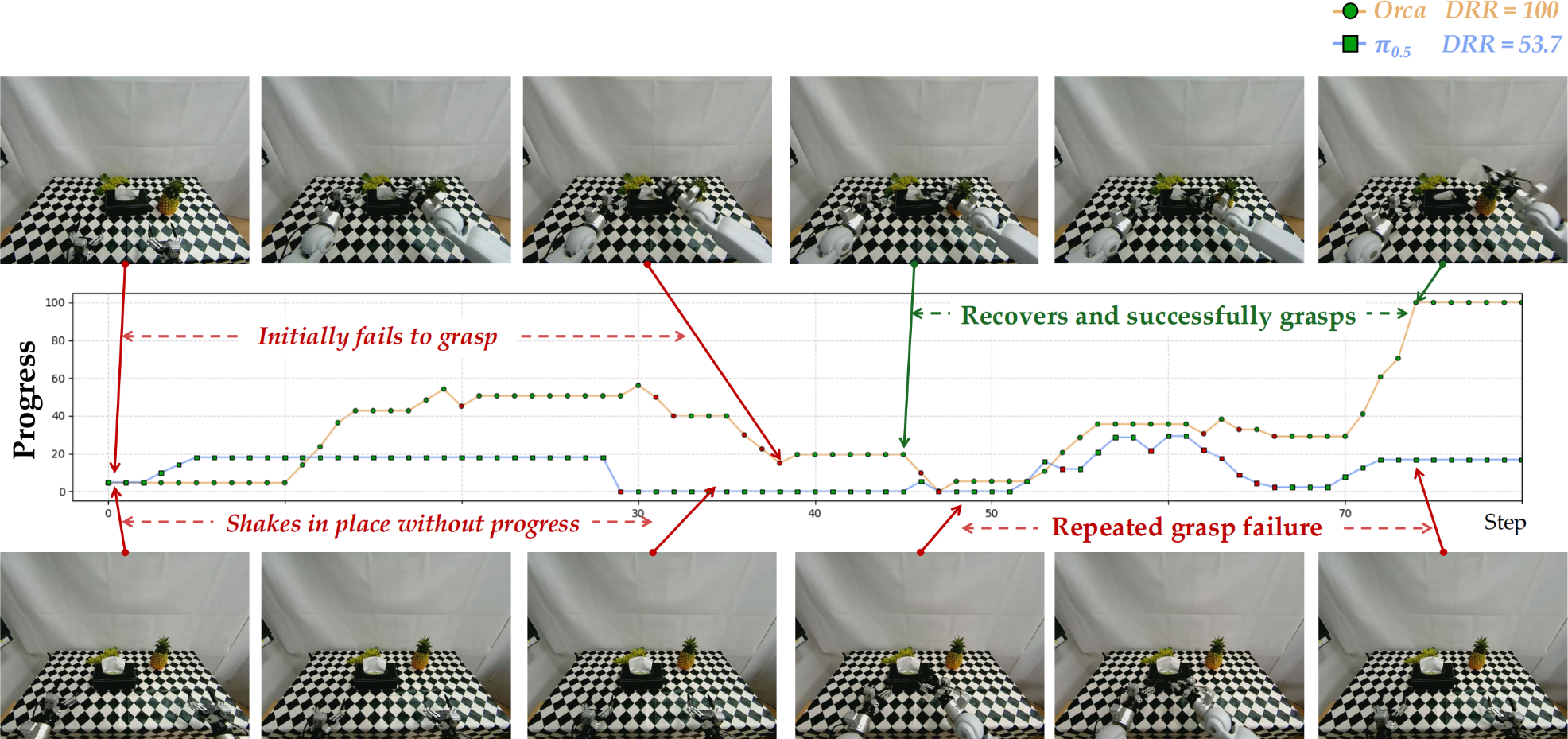
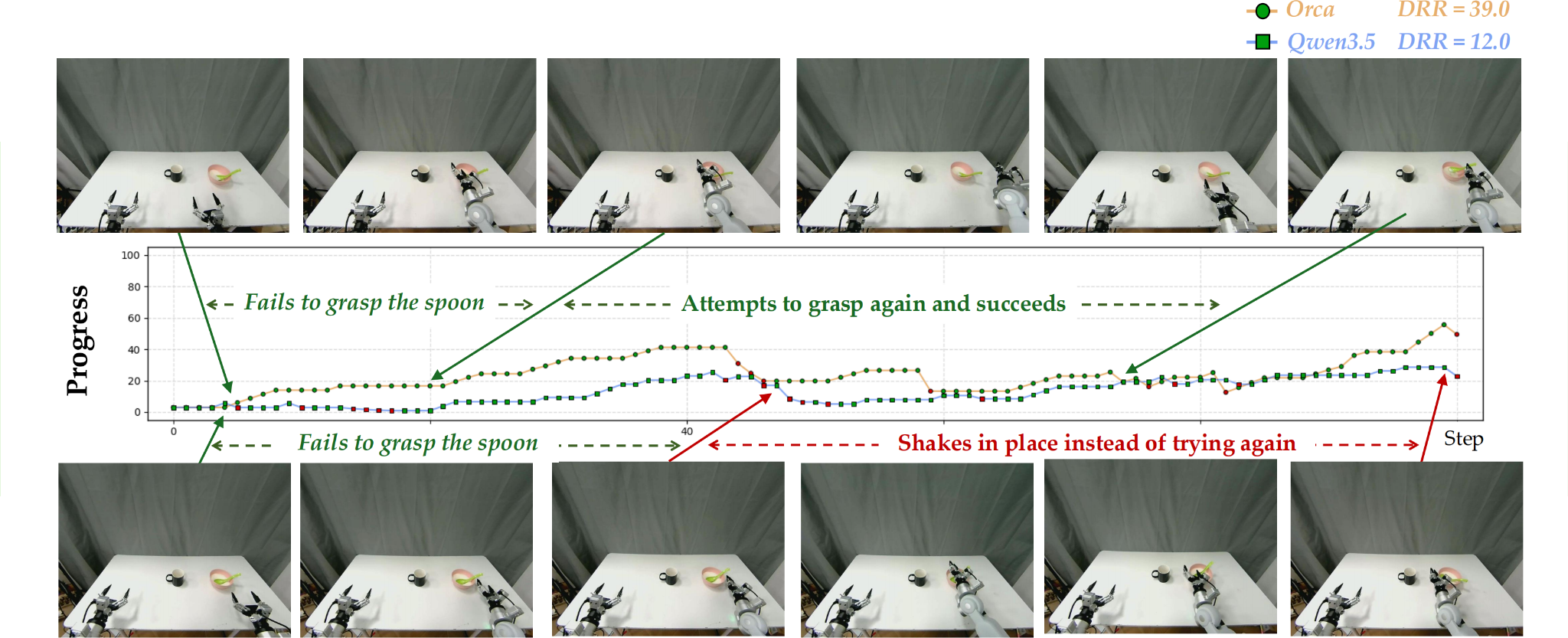
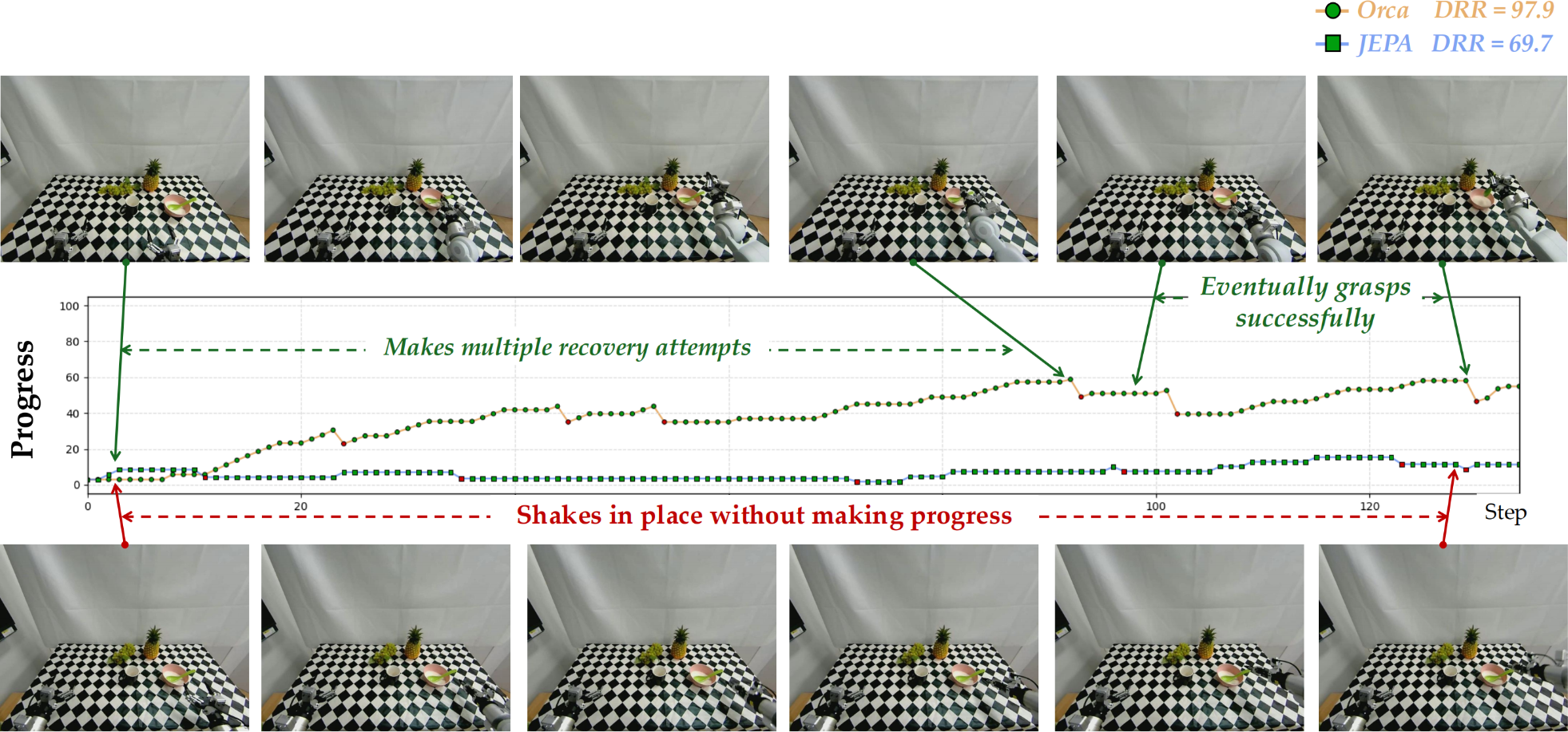
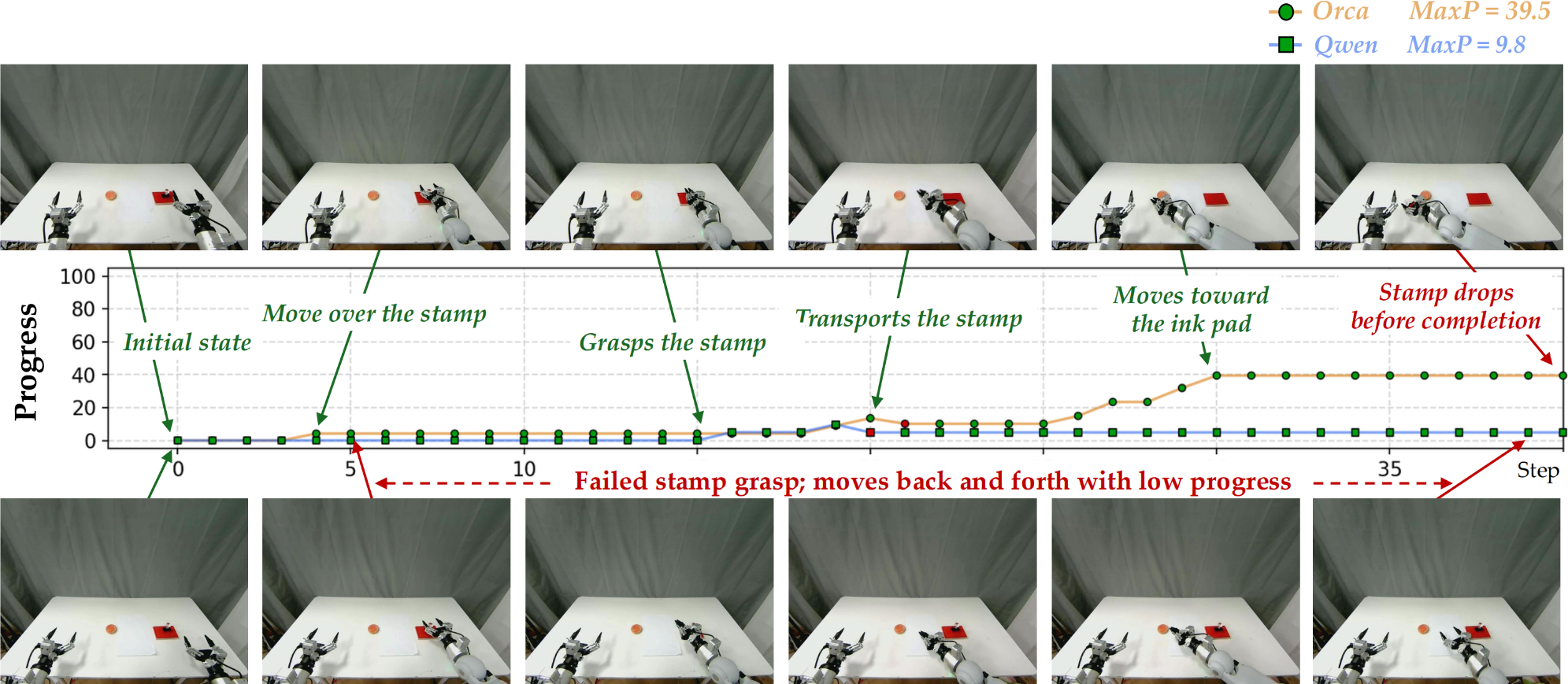
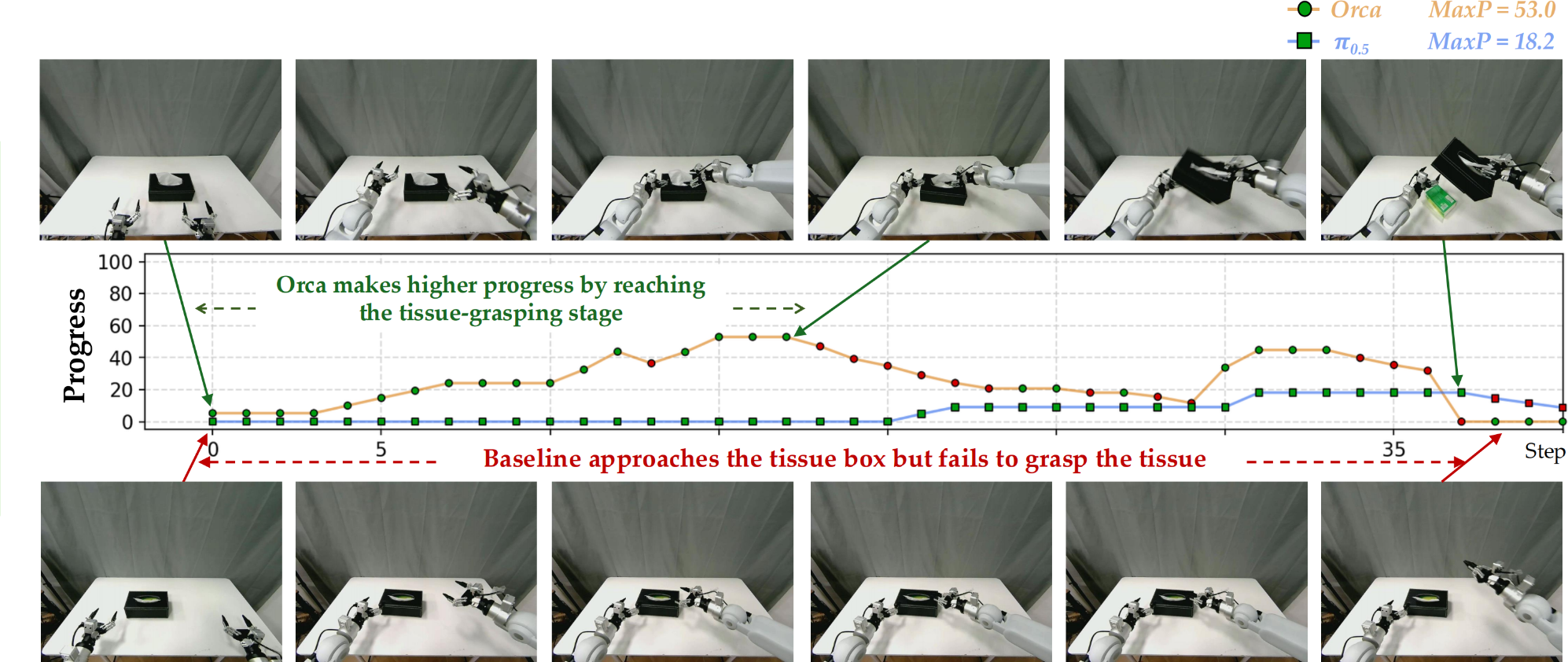
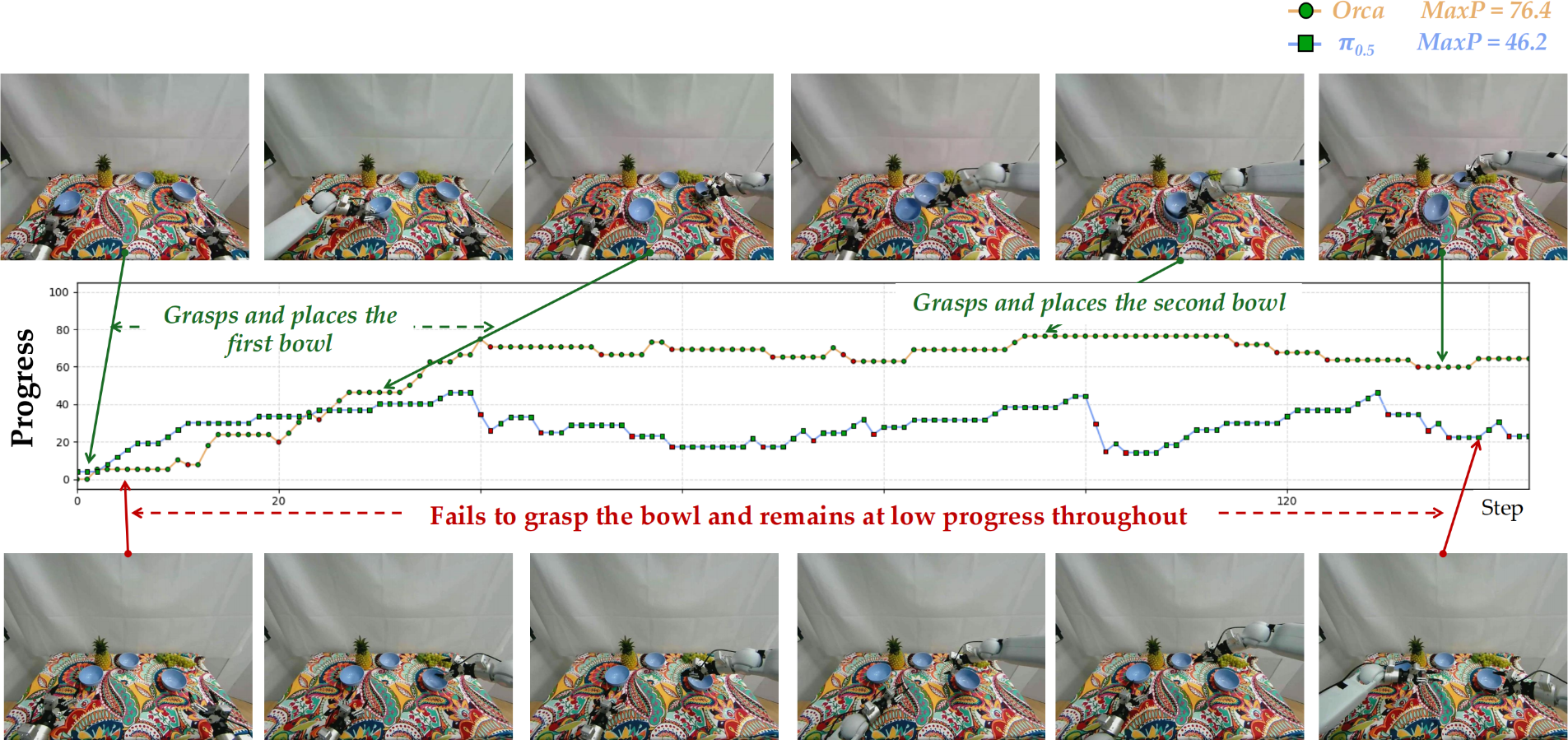
Recovery example 1.
We welcome more teams to use PRM-as-a-Judge for model evaluation, benchmark analysis, and policy diagnosis. Our team can provide technical support and evaluation consulting for collaborators who want to deploy dense trajectory auditing in their own embodied AI workflows.
The PRM-as-a-Judge 1.5 code package, easier-to-use toolkit, fuller experimental analysis, and technical report are planned for mid-July 2026.